

Introduction
The morning of August 27, 2025, started like any other first week of school at Annunciation School Shooting Catholic School in Minneapolis. Families dropped off their kids, teachers prepared for the day ahead, and students filed into church for a back-to-school Mass—a tradition meant to bless the new academic year with hope and community. Nobody could have predicted that within minutes, that sacred space would become the scene of unimaginable violence.
What unfolded that morning shattered a community, took innocent lives, and left a city searching for answers. Two children—eight-year-old Fletcher Merkel and ten-year-old Harper Moyski—were killed. Fourteen others were wounded, including students and elderly parishioners who had come to pray. The shooter, 23-year-old Robin Westman, a former student of the school, carried out an attack that authorities would later classify as domestic terrorism and a hate crime targeting Catholics.
This article looks at what happened that day, the lives lost, the survivors’ stories, and the investigation that followed. It also explores how a grieving community has channeled their pain into action, determined to ensure Fletcher, Harper, and the others are remembered not just for how they died, but for how they lived.
Timeline of the Attack: What Happened on August 27, 2025
A Morning Mass Interrupted
The first week of school at Annunciation Catholic School always included a special Mass. Parents, grandparents, and parishioners packed the pews alongside uniformed students. The church, with its beautiful stained glass windows and wooden pews worn smooth by generations of worshippers, felt like a sanctuary in every sense of the word.
Around 9:15 that morning, as the priest began the liturgy, the first sounds of gunfire erupted outside. Initially, many inside thought it might be construction noise or fireworks. But the popping sounds grew louder and closer, and then the windows began to shatter.
Shots Through Stained Glass
Robin Westman approached the church armed with three firearms, including an AR-15-style weapon later found at the scene. Investigators would determine that the shooter fired dozens of rounds through the stained glass windows, sending shards of colored glass raining down on terrified worshippers.
Children screamed. Parents threw themselves over their kids. Elderly parishioners, some using walkers and canes, tried desperately to find cover. The beautiful morning had turned into a nightmare in seconds.
Barricaded Doors
Here’s where the story gets even more chilling. Investigators discovered that some of the church doors had been barricaded from the outside with wooden planks. This detail, which emerged days after the shooting, suggested careful planning and a clear intention to trap people inside. The shooter didn’t just want to fire into the building—they wanted to make escape nearly impossible.
Firefighters and first responders who arrived on the scene had to work quickly to remove these barricades before they could reach the wounded inside. Those precious minutes likely made the difference between life and death for some victims.
Heroism in the Pews
Amid the chaos, stories of bravery emerged. Ten-year-old Weston Halsne later recounted how his friend Victor pushed him down and covered his body as bullets flew. “He saved my life,” Weston told reporters from his hospital bed. “He just yelled at me to get down and then he was on top of me.”
Teachers herded children into supply closets and under desks. A retired nurse who happened to be at Mass used her scarf as a tourniquet for a bleeding child. A father carried three kids at once to a back room while his wife tended to a wounded stranger.
These moments of humanity didn’t stop the tragedy, but they reminded everyone that even in the darkest moments, people find ways to care for one another.
The Victims: We Remember
The Young Lives Lost
Eight-year-old Fletcher Merkel loved dinosaurs and could name every species you threw at him. His parents described him as curious in the best way—always asking questions, always wanting to understand how things worked. He had just started second grade and was excited to finally be one of the “big kids” who got to help with classroom jobs.
Ten-year-old Harper Moyski was a dancer. Ballet, tap, jazz—she tried them all and loved every second. Her grandmother once said Harper danced through life, never walking anywhere when she could twirl instead. She had a laugh that filled rooms and a stubborn streak that her parents admitted came from them.
The families of both children have asked for privacy as they grieve, but they’ve also shared enough to let the world know who their kids were. Not just victims, but vibrant little people with futures stolen far too soon.
The Injured and the Healers
Beyond the two children killed, fourteen other students and three elderly parishioners were wounded. Some suffered injuries that required multiple surgeries. Others faced long roads to recovery that stretched well past the news cycles.
Hennepin County Medical Center became the focal point of the medical response. Trauma teams worked around the clock, with doctors later describing it as the kind of mass casualty event they trained for but hoped never to see. Pediatric specialists flew in from other hospitals to help. Mental health professionals set up impromptu counseling sessions for families in the waiting rooms.
First responders who arrived that morning have their own stories. Police officers who carried bleeding children to ambulances. Paramedics who worked triage in the church parking lot. Dispatchers who stayed on calls with terrified kids hiding in bathrooms. They don’t talk much about what they saw, but those who know them say the images haven’t faded.
Stories of Survival
Lydia Kaiser, an eighth-grader, became one of the most talked-about survivors after news spread of what she did. When the shooting started, Lydia was near a group of younger students. Instead of running for cover herself, she gathered several first-graders and pushed them into a small storage closet. As she closed the door, a bullet struck her in the head.
She survived. After emergency surgery at Hennepin County Medical Center, doctors said the bullet had somehow missed critical areas. When she woke up, her first question wasn’t about herself—it was about the little ones she’d tried to protect. All of them made it out physically unharmed.
Stories like Lydia’s spread through the community in the days after the shooting. A father who shielded his daughter and two strangers. A teacher who took a bullet in the arm while herding kids to safety. A janitor who ran toward the gunfire, not away, to warn people in other parts of the building.
These stories didn’t erase the tragedy. But they gave people something to hold onto amid the grief.
The Investigation: Unraveling the Shooter’s Motives
Who Was Robin Westman?
Robin Westman, 23, grew up in the neighborhood and had attended Annunciation School ShootingCatholic School as a child. His mother had worked at the school for several years, though she was no longer employed there at the time of the shooting. Former classmates described him as quiet, someone who kept to himself even as a kid.
Neighbors in the modest Minneapolis suburb where Westman lived with his parents told reporters they rarely saw him. He kept odd hours, they said, and sometimes they’d hear music playing late at night from his basement room. Nothing about him screamed “danger” to the people who lived nearby.
In the weeks after the shooting, investigators pieced together a picture of a troubled young man who had spent months planning the attack. His internet history showed searches about previous mass shooters. He’d researched the layout of the church. He’d purchased weapons legally, passing background checks despite what friends would later describe as increasingly disturbing social media posts.
The Manifesto and YouTube Videos
Days before the shooting, Westman uploaded several videos to YouTube that investigators later described as a “digital roadmap” of his plans. In one, he showed weapons spread out on his bedroom floor. In another, he’d drawn a crude sketch of the church with arrows showing where he’d position himself.
A manifesto timed to publish online moments after the shooting began laid out his grievances in rambling, often incoherent detail. He wrote about feeling wronged by society, about anger toward organized religion, about what he called “the system” that had failed him. The document jumped between topics with no clear through-line, but one theme emerged consistently: an obsession with killing children.
Law enforcement officials who analyzed the manifesto said it fit patterns seen in other mass casualty events. The shooter wanted notoriety. He wanted to be remembered. He wanted to cause maximum pain before ending his own life, which he did as police closed in.
An “Act of Domestic Terrorism”
FBI Director Kash Patel personally announced that the bureau was investigating the shooting as both domestic terrorism and a hate crime targeting Catholics. This dual classification mattered for legal and symbolic reasons. It acknowledged that the shooter had targeted a specific religious community and that the violence was intended to terrorize beyond the immediate victims.
The investigation involved dozens of FBI agents combing through digital evidence, interviewing witnesses, and trying to determine whether anyone else had known about or assisted with the plans. No evidence of co-conspirators emerged, but the investigation continued for months after the shooting.
A Heart “Full of Hate”
Perhaps most disturbing were the writings found on the weapons themselves. On the AR-15, investigators found scrawled messages expressing racism, antisemitism, and anti-Catholic sentiment. One line, crudely written in marker, read “Kill Donald Trump”—a reference to the former president that confused investigators given the target of the attack.
The hateful messages suggested a young man who had absorbed extremist ideologies from various online sources. He blamed Catholics for historical grievances. He expressed antisemitic conspiracy theories despite having no known connection to Jewish communities. He wrote about racial hatred even though his own background didn’t fit the typical profile of white supremacist shooters.
Experts who study mass violence told reporters that the shooter’s ideology seemed less like a coherent belief system and more like a stew of resentments gathered from dark corners of the internet. He wanted to hate, so he found reasons to hate.
The Question of Motive
Months after the Annunciation School Shooting authorities acknowledged that they might never fully understand why Robin Westman did what he did. Unlike some mass shooters who leave behind detailed manifestos explaining their Annunciation School Shooting political or ideological motivations, Westman’s writings were too scattered to provide clear answers.
What investigators could say with confidence was that the shooter had planned carefully, targeted a vulnerable community, and shown particular cruelty in barricading doors to prevent escape. The primary finding, as one official put it, was an “obsession with killing children” that transcended any single ideological explanation.
This lack of clear motive left some community members frustrated. They wanted answers that would help them make sense of the senseless. But violence of this kind rarely makes sense, no matter how many times we try to explain it.
The Aftermath: Grief, Community, and a Call for Change
A Community Mourns
In the days following the shooting, thousands gathered for vigils outside the church. The crowd spilled onto surrounding streets, people holding candles and signs with the children’s names. Archbishop Bernard Hebda spoke at one gathering, his voice breaking as he described the bravery shown during the attack.
“There was love in that church before there was violence,” he told the crowd. “And that love didn’t disappear when the violence started. It showed itself in how people protected each other, how they cared for each other, how they refused to let hate have the final word.”
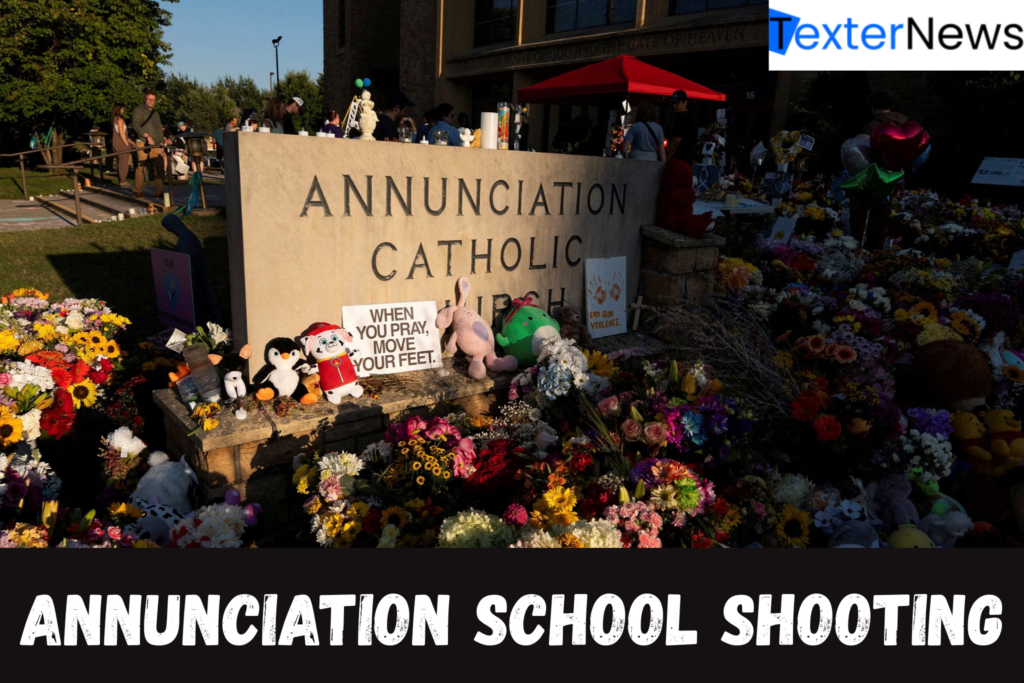
The vigils drew people of all faiths and none. Neighbors who’d lived on the same block for decades without speaking hugged each other. Kids left stuffed animals and drawings at a makeshift memorial near the church entrance. For a few days, at least, the community came together in shared grief.
Pray with Your Feet
Matt DeBoer, the principal of Annunciation School Shooting Catholic School, became an unexpected voice in the days after the Annunciation School Shooting In an emotional press conference, he thanked first responders and asked for privacy for grieving families. But then he said something that stuck with people.
“Prayer is important,” he told reporters. “We’re a Catholic school, we believe in prayer. But you also have to pray with your feet. You have to move. annunciation School Shooting You have to act. Thoughts and prayers aren’t enough if they don’t lead to change.”
His words resonated beyond the immediate community. They captured a growing sentiment among people tired of seeing their kids go through active shooter drills, tired of watching news reports about yet another mass Annunciation School Shooting tired of waiting for something to change.
Legislative Impact and the
In the months after the Annunciation School Shooting Minnesota Governor Tim Walz proposed several gun safety measures, including expanded background checks and a “red flag” law that would allow courts to temporarily remove firearms from people showing signs of dangerous behavior. Similar proposals had failed in past legislative sessions, but supporters hoped this tragedy might be different.
Perhaps the most significant development came from within the grieving community itself. Parents of students at Annunciation School Shooting formed an advocacy group they called the Annunciation Light Alliance. The name came from a phrase one parent used at a support group meeting: “They tried to put out our light, but we’re still here. We’re still shining.”
The Alliance focused on practical changes—school security improvements, mental health resources for students, and advocacy for state and federal legislation. They weren’t trying to become political activists, they said. They were just parents who didn’t want other families to experience what theirs had.
A City on Edge
The Annunciation School Shooting didn’t happen in isolation. Minneapolis had already been dealing with elevated violent crime rates, and the annunciation School Shooting added to a sense that the city was spiraling. Mayor Jacob Frey faced tough questions about public safety, and police resources were stretched thin responding to multiple crises.
For families directly affected by the annunciation School Shooting the broader context didn’t matter much. They were focused on their own recovery, their own grief, their own attempts to piece together normal life after everything fell apart. Some children refused to go back to school. Some parents couldn’t enter a church without panicking. The trauma rippled outward in ways that would take years to fully understand.
Conclusion
The Annunciation school shooting was an act of incomprehensible cruelty. It took two beautiful children from families who loved them. It wounded more than a dozen others, some of whom will carry physical and emotional scars for the rest of their lives. It shattered the sense of safety that every community deserves.
But the story doesn’t end there. It also includes Lydia Kaiser, waking up from surgery and asking about the kids she protected. It includes Victor, the boy who covered his friend Weston when the bullets flew. It includes parents who turned their grief into advocacy, teachers who ran toward danger, and a community that refused to let hate have the final word.
Fletcher Merkel loved dinosaurs. Harper Moyski danced through life. Those facts matter more than anything about the person who killed them. In the end, the Annunciation School Shooting community’s determination to honor their children by fighting for change, by supporting each other, and by refusing to be defined by violence might be the most powerful response of all.
The shooting happened on a Tuesday morning in August. But the work of healing—of remembering, of advocating, of loving—happens every day after. And that work continues.



Pingback: beef broth: simple nourishing and surprisingly powerful -
Pingback: Pepperoni: Types Ingredients Nutrition & Best Ways to Use It -