

Introduction
We’ve all heard it. Maybe you’ve said it yourself after a particularly brutal Monday morning meeting or a stressful week. “I really ran the gauntlet today.” It’s a phrase that instantly paints a picture of struggle, of having to push through one difficult thing after another. It’s a colorful bit of language that has stuck around for centuries, and for good reason. Life, after all, has a way of throwing a series of challenges our way.
This article is going to unpack that powerful idiom. We’ll look at what it really means to “run the gauntlet,” where this strange-sounding phrase came from, and why it’s still the perfect way to describe so many of our modern hardships. We’ll explore everything from its brutal historical origins to the everyday situations where it feels like you’re just trying to survive the next obstacle.
What Does “Run the Gauntlet” Really Mean?
At its simplest, to run the gauntlet means to go through an intimidating or dangerous situation where you are attacked or criticized from all sides. It’s about facing a series of troubles, one after another.
The literal meaning is a thing of the past, a historical punishment we’ll get to shortly. But the figurative meaning is alive and well. When someone says they had to run the gauntlet, they’re talking about enduring hardship or having to face intense criticism. Think of a politician facing tough questions from the press, a new employee being grilled by a panel of interviewers, or even just having to walk past a group of hecklers. You’re not physically running between two lines of people with clubs, but you are having to withstand pressure and survive a difficult test.
Common contexts for the phrase are everywhere. You might hear it in sports, describing a team with a series of tough away games. In business, it could be a startup trying to secure funding, having to go through the gauntlet of investor meetings. For a student, finals week can feel like a trial by ordeal. The core idea is always the same: a challenging experience that requires grit and determination to get through.
The Grim Origin: A History of Punishment
So, where does this evocative phrase come from? The origin of “run the gauntlet” is far more literal and brutal than its modern usage. Its roots are in the military, specifically as a form of punishment.
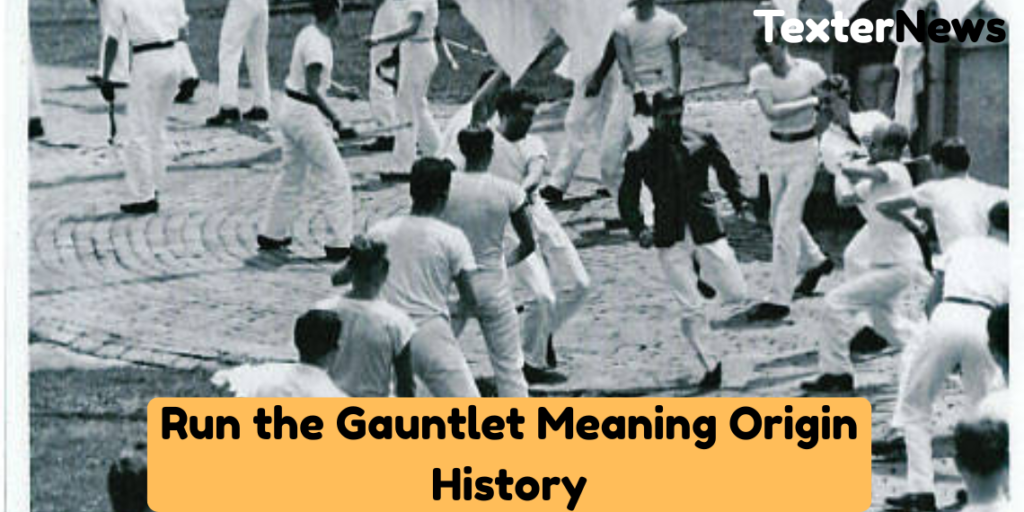
The practice dates back centuries, with similar forms appearing in various cultures, but it was most famously used in the European military systems, particularly by the Romans and later by armies in Sweden, Russia, and other parts of Europe. The offending soldier would be forced to walk or run between two long lines of his fellow soldiers. Each man in the line was armed with a stick, a club, or a knotted rope, and would strike the condemned man as he passed.
This was known as “running the gantlet.” The word itself is key here. The original term was “gantlope,” from the Swedish word gatlopp, which simply means “lane run.” Over time, the English language corrupted “gantlope” into the more familiar-sounding “gauntlet.” This is where the common confusion between run the gauntlet vs gantlet comes in. Technically, the punishment is “running the gantlet.” However, “gauntlet” also means a type of glove, which led to another common phrase, “throw down the gauntlet” (meaning to issue a challenge). Because the two words sounded so similar, they became intertwined. Today, “run the gauntlet” is the overwhelmingly accepted and understood spelling, even if historians might prefer the original “gantlet.”
The practice was a severe trial, a brutal form of discipline designed to punish and humiliate. It was a demanding situation that the soldier was forced to endure, and many did not survive the ordeal. The intended purpose was to make an example of the offender, enforcing discipline through a shared, brutal act carried out by the entire unit.
The End of a Brutal Practice and the Start of an Idiom
Over time, military justice evolved, and such extreme physical punishments began to be seen as barbaric. By the 19th century, the formal practice of running the gantlet as a punishment was largely phased out in most professional armies. But the phrase had already taken root in the language.
People understood the visceral image: a person forced to confront obstacles and face attacks from both sides. It was too powerful a metaphor to abandon. The phrase moved from the parade ground into everyday speech. Instead of literal clubs, people spoke of having to face the music or weather the storm of public opinion. A politician might have to run the gauntlet of public scrutiny. A whistleblower might have to endure the gauntlet of legal challenges.
The meaning shifted from a physical punishment to a psychological and social one. It became the perfect way to describe any situation where someone is under fire. A new product launch, for instance, might have to survive the gauntlet of consumer reviews. A debut novel must pass through the gauntlet of literary critics. The idea of being thrown into the deep end at a new job, having to learn quickly while facing constant challenges, is a perfect modern equivalent.
Modern Trials: Running Your Own Gauntlets
We may not face lines of soldiers with clubs anymore, but life is still full of situations where we have to run the gauntlet. Think of it as your personal trial by fire. A baptism by fire is a close cousin—it’s when you’re thrust into a difficult situation right from the start. That first year of running your own business? That’s a gauntlet. Going through a painful divorce and having to deal with the emotional and legal fallout? That’s a gauntlet.
Everyday life offers its own mini-gauntlets. Consider the daily commute during a transit strike, a true test of overcome adversity. Or the process of applying for a mortgage, which can feel like going through the gauntlet of paperwork and bank requirements. Parenting a teenager can certainly feel like a challenging experience where you have to confront obstacles at every turn. It’s an uphill battle.
These experiences are all part of the human condition. They are the testing circumstances that shape us. They are harsh treatment from the world that we must find a way to navigate. It’s about withstanding pressure not just to survive, but to grow. The phrase “run the gauntlet” endures because it so perfectly captures that feeling of being in a demanding situation with no easy way out, only a way through.
Synonyms and Shades of Meaning
The richness of this idiom is reflected in the many other phrases we use to describe similar struggles. While “run the gauntlet” has its own unique flavor, these synonyms help paint the full picture of overcome adversity:
- Face the music: This implies facing the consequences of your actions. It’s less about a series of attacks and more about one final, unavoidable confrontation.
- Weather the storm: This focuses on endurance, on surviving a turbulent period until things calm down. It’s passive but powerful.
- Thrown into the deep end: This is about being forced to handle a difficult situation without any preparation. It’s a sudden, overwhelming challenge.
- Under fire: This is very close to the original gauntlet imagery, suggesting you are actively being attacked or criticized.
- Uphill battle: This emphasizes the difficulty and effort required, like constantly fighting against gravity.
- Rite of passage: This adds a cultural or personal significance, suggesting the struggle is a necessary step toward a new stage in life.
- Trial by ordeal / Baptism by fire: Both of these suggest a difficult experience that tests you, often one that is your first introduction to something.
Using these phrases adds color and nuance to our language, allowing us to describe the specific nature of a tough journey. Whether you’re running the obstacle course of a new fitness challenge or surviving the gauntlet of a family dinner with opposing political views, these words give us a shared vocabulary for struggle.
Conclusion: Why We Keep Running
The phrase “run the gauntlet” is more than just a relic of a brutal past. It’s a testament to the human experience of facing hardship. It acknowledges that life is not always a smooth path. Sometimes it’s a narrow corridor lined with difficulties, and the only way forward is through.
We use the phrase today because it’s honest. It doesn’t sugarcoat the harsh treatment or the difficult challenge. It validates the feeling of being under siege, of having to withstand pressure from all sides. But it also carries an undercurrent of resilience. To run the gauntlet and survive implies strength. It means you have the grit to confront obstacles and the determination to overcome adversity.
So the next time you find yourself in a demanding situation, remember the history of the words you might use to describe it. You’re not just complaining; you’re tapping into a centuries-old expression of human struggle and survival. You are, in a very real sense, going through the gauntlet, and coming out the other side.